ScaleMule Cloud
Available
Hosted offering: Hosted production infrastructure for product teams moving generated product logic into customer-ready AI and API systems.
Open
Generated product logic still needs stable production boundaries. ScaleMule keeps access, tenant context, events, storage, billing concepts, and audit workflows explicit so products can move from prototype to customer-ready systems.
What ScaleMule provides
This public model explains how product-specific logic sits above a reusable ScaleMule platform layer, which in turn sits above the underlying infrastructure substrate.
Architecture review scopes the first deployment; the reusable control layer is the product.
Public reference model
Features, workflows, agents, APIs, and product-specific behavior.
Tenant-aware access, events, storage, media, audit trails, billing foundations, usage visibility, and operational workflows.
Cloud, storage, databases, queues, compute, AI/GPU capacity, and provider-specific infrastructure.
Product packaging
The public architecture is intentionally conceptual. It explains the shared control model while keeping authenticated docs and internal implementation details private.
Core concepts
The architecture centers on boundaries and workflows that should remain consistent as a product moves from prototype to customer-ready service.
Application and environment context before product logic.
Tenant-aware data access and operational records.
Scoped API keys, roles, and service access paths.
Inspectable event, webhook, and background workflow behavior.
API keys, application context, environment boundaries, and role policy concepts are treated as platform primitives instead of ad hoc route logic.
Customer and application boundaries are carried through request handling, data operations, files, events, and operational review paths.
Backend-heavy products can use event delivery, webhook review, retries, and operational logs as part of the shared platform model.
Commercialization workflows are designed around usage visibility, billing integration points, and customer lifecycle operations.
Audit timelines, delivery review, support investigation, and release operations are framed as first-class product concerns.
Architecture discussions, onboarding plans, isolated deployment considerations, and contracting questions can be reviewed during evaluation.
Flow
The first pass stays concrete: define the surface, map the production boundary, then review the path through Cloud or MuleOS.
Features, agents, workflows, APIs, and customer-facing behavior.
Tenant context, access scope, events, storage, audit trails, usage visibility, and billing foundations.
Cloud onboarding for product teams or MuleOS provider review for infrastructure operators.
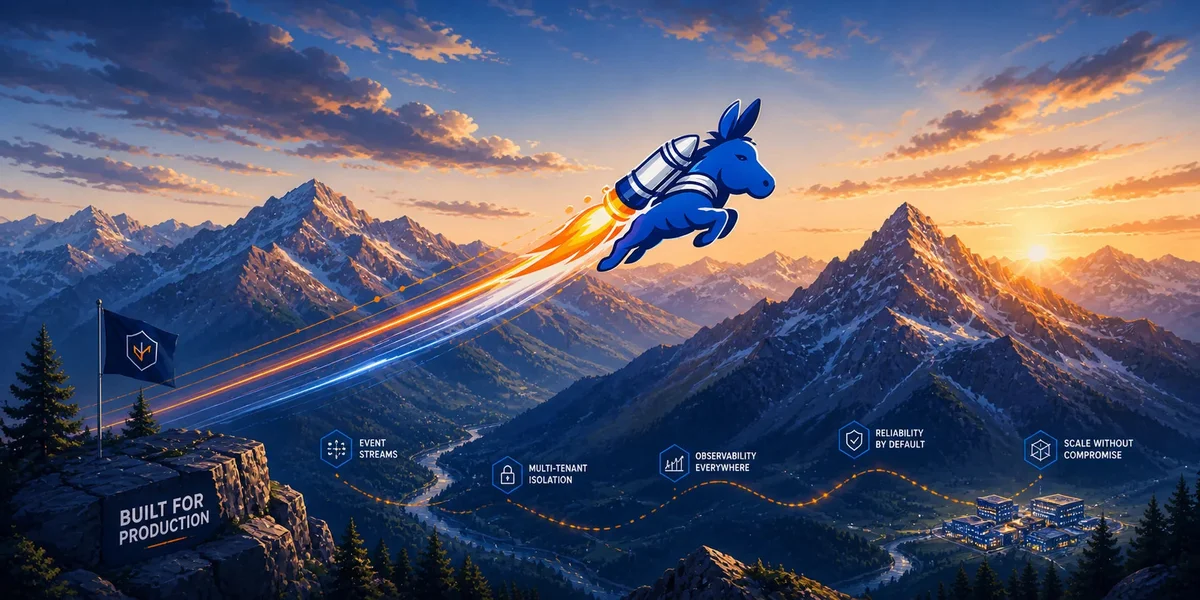
Production boundaries
Keep the control layer explicit.
Product logic moves faster. Access, tenant context, events, storage, and audit workflows still need a stable production model.
Boundaries
Customer documentation, internal service details, secrets, infrastructure runbooks, and customer-specific implementation materials are not published on the public site.
Evaluation-level architecture is public.
Detailed customer docs stay authenticated.
Implementation specifics are reviewed selectively.
Enterprise scoping happens during evaluation.
Bring the workflow, tenant model, event needs, billing assumptions, and security questions. The review focuses on whether ScaleMule is a credible production foundation for the product you are building.