
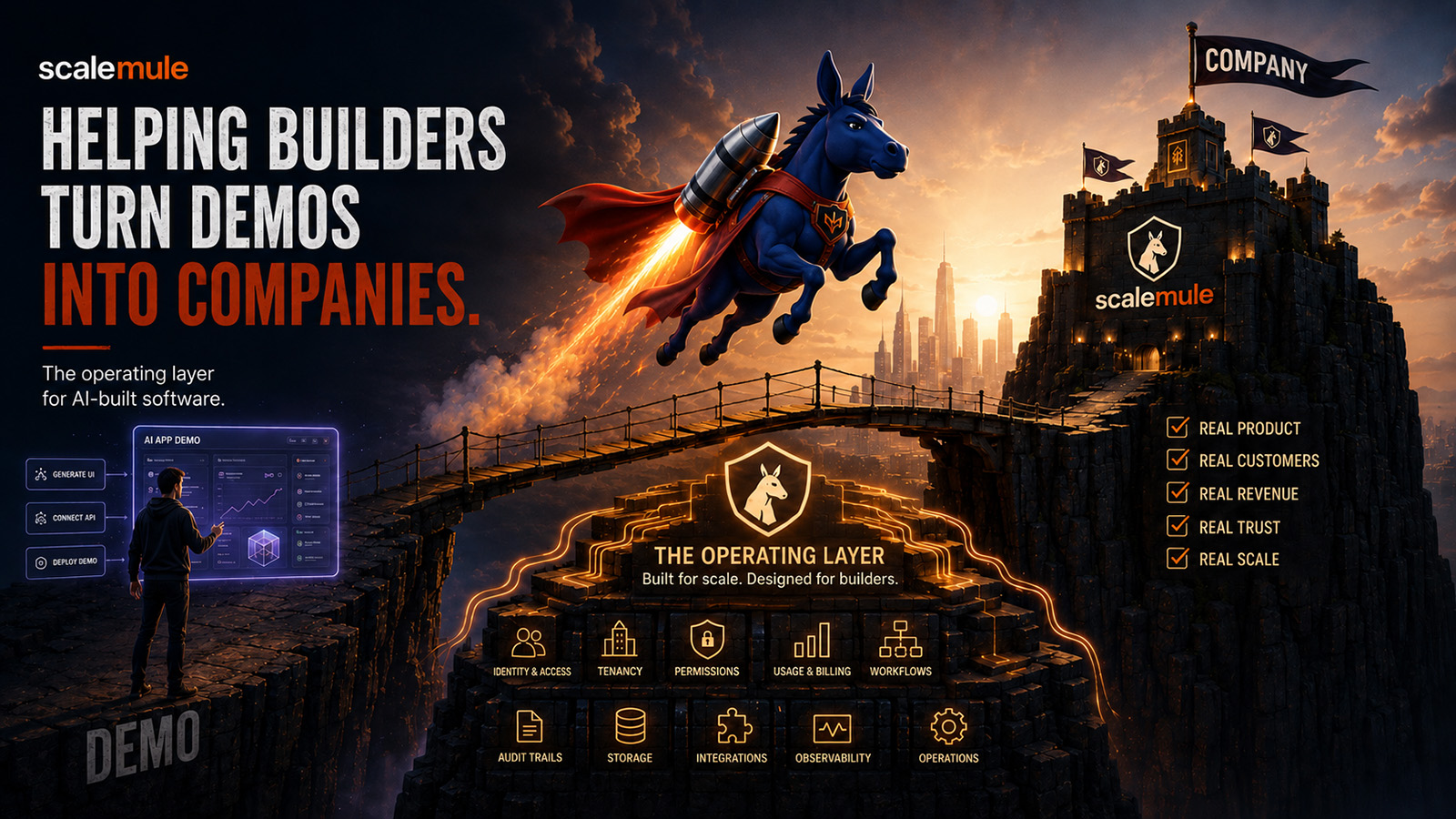
AI has made prototypes abundant. The new bottleneck is turning them into real businesses.
AI has collapsed the cost of creating a software demo.
That is not a small change. It means more people can build, more ideas can be tested, and more products can reach customers without waiting for a traditional engineering team.
A founder can describe an idea, generate a working interface, connect a few APIs, record a product video, and show something that feels surprisingly complete.
This is one of the most important shifts in software.
But when one bottleneck disappears, another becomes visible.
The new bottleneck is not the demo.
The new bottleneck is turning the demo into a company.
A demo can show what a product might become. A company has to deliver that product to real customers, under real constraints, with real accountability.
Customers do not buy demos. They buy outcomes. They buy reliability. They buy trust. They buy software that works for their team, their data, their workflow, their permissions, their budget, and their business.
That is where many AI-built products start to struggle.
The bottleneck has moved
For a long time, getting the first version working was one of the hardest parts of building a software company.
You needed design, frontend engineering, backend infrastructure, authentication, deployment, databases, integrations, and a team that could turn an idea into something usable.
That barrier protected incumbents. It slowed down new entrants. It made software company creation expensive.
AI is changing that.
The first version is becoming easier to create. The prototype is becoming cheaper. The demo is becoming faster. The distance between imagination and interface is shrinking.
This does not mean company-building becomes easy.
It means the hard part moves.
The scarce capability is no longer just writing software. The scarce capability is turning software into a business that can be sold, operated, governed, supported, and trusted.
That is a very different problem.
A product can work in a demo and still not be ready for customers.
It may not have real billing. It may not support teams. It may not isolate customer data. It may not have roles and permissions. It may not track usage. It may not produce audit trails. It may not handle onboarding. It may not support upgrades, cancellations, limits, support workflows, integrations, or operational visibility.
Those are not decorative features.
They are the commercial foundation.
The demo is the new starting line
The demo is not the problem.
The demo is the new starting line.
A good demo helps people understand the idea. It helps founders learn. It helps investors see the direction. It helps customers react to something concrete.
But the demo is not the company.
The company begins when someone wants to use the product for real.
Then another person needs to be invited.
Then a team needs a workspace.
Then a customer asks how billing works.
Then someone needs an admin role.
Then someone wants usage limits.
Then someone asks whether their data is separate from everyone else's.
Then someone wants support.
Then someone wants an audit trail.
Then someone asks what happened yesterday.
Then someone needs an integration.
Then someone needs to upgrade.
Then someone needs to cancel.
Then someone inside a larger organization asks whether the product can be trusted.
That is when the product crosses from prototype into business.
And that is where most of the real work begins.
The invisible layer becomes the company
Most demos show the visible part of software.
The screen. The workflow. The AI response. The dashboard. The magic moment.
But companies are built on the invisible layer underneath.
Identity. Tenancy. Permissions. Billing. Usage. Workflows. Storage. Auditability. Operational controls. Customer onboarding. Support. Integrations. Reliability.
These parts are not usually what make the demo exciting.
They are also the reason the product can be used by real customers.
A beautiful demo can get attention. A reliable operating layer turns that attention into revenue.
This is the part many builders underestimate because it feels boring. But in commercial software, the boring parts are often the business.
The customer does not only ask, "Does it work?"
The customer eventually asks:
Can my team use it? Can I control access? Can I pay for it? Can I trust it? Can I understand what happened? Can I integrate it into my workflow? Can I depend on it tomorrow? Can I expand usage safely?
A product that cannot answer those questions is still closer to a demo than a company.
AI makes the operating layer more important
The easy conclusion is that AI will make software companies cheaper to build.
That is true.
But the deeper conclusion is that AI shifts the scarce part of company creation from writing code to commercializing, governing, and operating software.
As software becomes more dynamic, more automated, and more agentic, the need for boundaries increases.
Who is allowed to do what? Which customer does this action belong to? What data can be used? What should be logged? What should be billed? What should be limited? What should require review? What should be reversible? What happens when something fails?
These questions become more important when the software is more capable.
AI does not remove the need for infrastructure. It raises the standard for the infrastructure underneath the product.
An AI-generated prototype may be enough to prove an idea. An AI-powered business needs identity, tenancy, permissions, usage tracking, workflows, auditability, billing, storage, integrations, and operational controls.
Without those pieces, every new feature becomes harder to support. Every new customer adds risk. Every new workflow creates another custom path. Every new integration increases fragility.
The product may still look simple from the outside.
But underneath, the operating layer has to become stronger.
Software creation is becoming abundant
When the cost of creating software falls, the number of software products should increase.
That is the optimistic view.
More people should be able to build. More industries should get better tools. More workflows should be automated. More businesses should be started by people who understand a customer problem but could not previously assemble a full engineering team.
AI should create more software companies, not fewer.
But there is a constraint.
If every builder has to rebuild the same commercial foundation from scratch, the market will waste enormous energy recreating the same core systems over and over again.
Every new product should not need to reinvent identity, teams, permissions, billing, usage, onboarding, audit trails, workflows, storage, integrations, and operational controls.
Those systems are necessary, but they are rarely where the product should differentiate.
The opportunity is to standardize the core.
Builders should differentiate at the edge: the customer experience, the workflow, the vertical insight, the AI behavior, the product taste, the distribution, and the business model.
But the core operating layer should become reusable.
That is how more demos become companies.
The next software companies will look different
The next generation of software companies will not be built exactly like the last one.
A small team will be able to create more product surface area than before. A founder will be able to test more ideas. A vertical expert will be able to build software around a workflow they understand deeply. A company will be able to launch faster without waiting for every piece of infrastructure to be custom-built.
But speed alone will not be enough.
The winners will not simply be the builders with the most prototypes.
The winners will be the builders who can turn prototypes into operating businesses fastest.
That means getting from demo to customer. From customer to revenue. From revenue to repeatability. From repeatability to trust. From trust to scale.
The market will reward the companies that can cross that gap.
The prototype proves that something can exist.
The operating layer proves that it can become a business.
ScaleMule exists for that gap
ScaleMule is the operating layer for AI-built software: the reusable core that helps builders turn prototypes into commercial products.
We believe AI will make it dramatically easier to create software. But companies will still need the commercial foundation required to sell, operate, support, govern, and scale that software.
That foundation includes identity, tenancy, billing, usage, workflows, permissions, auditability, storage, integrations, and operational controls.
These are not the glamorous parts of the product.
They are the parts that make the product real.
ScaleMule helps builders standardize the core so they can differentiate at the edge.
The edge is where the magic should happen: the customer experience, the AI workflow, the vertical insight, the unique product, the thing customers actually remember.
The core should not have to be rebuilt from zero every time.
If AI makes software creation abundant, then the operating layer becomes more valuable. It becomes the bridge between prototype and company.
A demo can start the conversation
A demo is valuable.
It can show the idea. It can create belief. It can help a founder learn faster. It can make a customer say, "I want this."
But the demo is the beginning, not the business.
The real work starts when someone wants to use it. Then a team wants to depend on it. Then an organization wants to pay for it. Then customers expect it to work every day.
That is when the question changes.
Not just:
Can this be built?
But:
Can this be operated? Can this be trusted? Can this be sold? Can this be supported? Can this become a company?
AI has made the first question easier.
ScaleMule is focused on the rest.
A demo is not a company.
But with the right operating layer, it can become one.
From demo to product
Turn AI-built software into a commercial product
See how ScaleMule helps builders connect customer-ready products to a reusable operating layer for identity, teams, permissions, billing, usage, workflows, auditability, onboarding, and operational control.