Everyone is trying to make AI agents more autonomous.
That is understandable. The demos are compelling. An agent can inspect a task, decide what needs to happen, call tools, update records, write code, trigger workflows, and report back with a finished result.
But autonomy is not the only thing that matters.
The harder production question is not:
Can the agent complete the task?
It is:
What can the agent touch when it is wrong?
That question is becoming one of the central infrastructure problems in agentic AI.
Recent joint guidance from the NSA, CISA, and allied cybersecurity agencies warned organizations to treat agentic AI as a real cybersecurity concern, especially when agents are connected to external tools, databases, memory stores, and automated workflows. The guidance calls out risks around excessive privilege, insecure configuration, unpredictable behavior, structural complexity, and accountability gaps.
That is the right framing.
The future of agentic AI is not just about giving agents more tools.
It is about giving agents safe boundaries.
The demo is not the product
In a demo, an agent can be impressive because the environment is small.
It has a limited task. It has a limited set of tools. It operates on sample data. The consequences are low.
If something goes wrong, the developer can reset the environment and try again.
Production is different.
In production, the agent may be acting on behalf of a real customer, inside a real workspace, with access to real data, billing state, permissions, files, media, workflows, integrations, and operational systems.
The same action that feels magical in a sandbox can become dangerous in a live environment.
A demo agent that updates a mock record is useful.
A production agent that updates the wrong customer record, changes the wrong permission, deletes the wrong file, or triggers the wrong workflow creates a very different kind of problem.
The issue is not only whether the model answered correctly. The issue is what durable state the agent was allowed to mutate.
Imagine a support agent that can summarize a ticket, draft a reply, issue a refund, update account permissions, and trigger a retention workflow.
In a demo, that looks powerful.
In production, each of those actions needs a different permission level, audit trail, approval policy, and rollback path.
The problem is not whether the agent can perform the task. The problem is whether the system can contain the task.
Agents change the backend problem
Traditional software usually acts through paths that developers designed ahead of time.
A user clicks a button. The application calls a known endpoint. The endpoint validates the request. The system writes to the database. The event is logged.
There are still bugs, of course. But the shape of the action is usually known.
Agents change that pattern.
An agent may decide which tools to call. It may sequence actions in a way the developer did not explicitly script. It may combine data from multiple systems. It may interpret instructions from emails, documents, tickets, chats, or web pages. It may continue operating across several steps before a human sees the result.
That flexibility is exactly what makes agents powerful.
It is also what makes infrastructure harder.
When an agent can act, the backend has to answer questions that many products were not originally designed to answer:
Who or what is acting? On behalf of which user, customer, workspace, or organization? What permission envelope applies to this action? Which tools are available in this context? What state can be changed? What needs human approval? What gets logged? What can be reversed? Who pays for the usage?
Without clear answers, autonomy becomes an uncontrolled surface area.
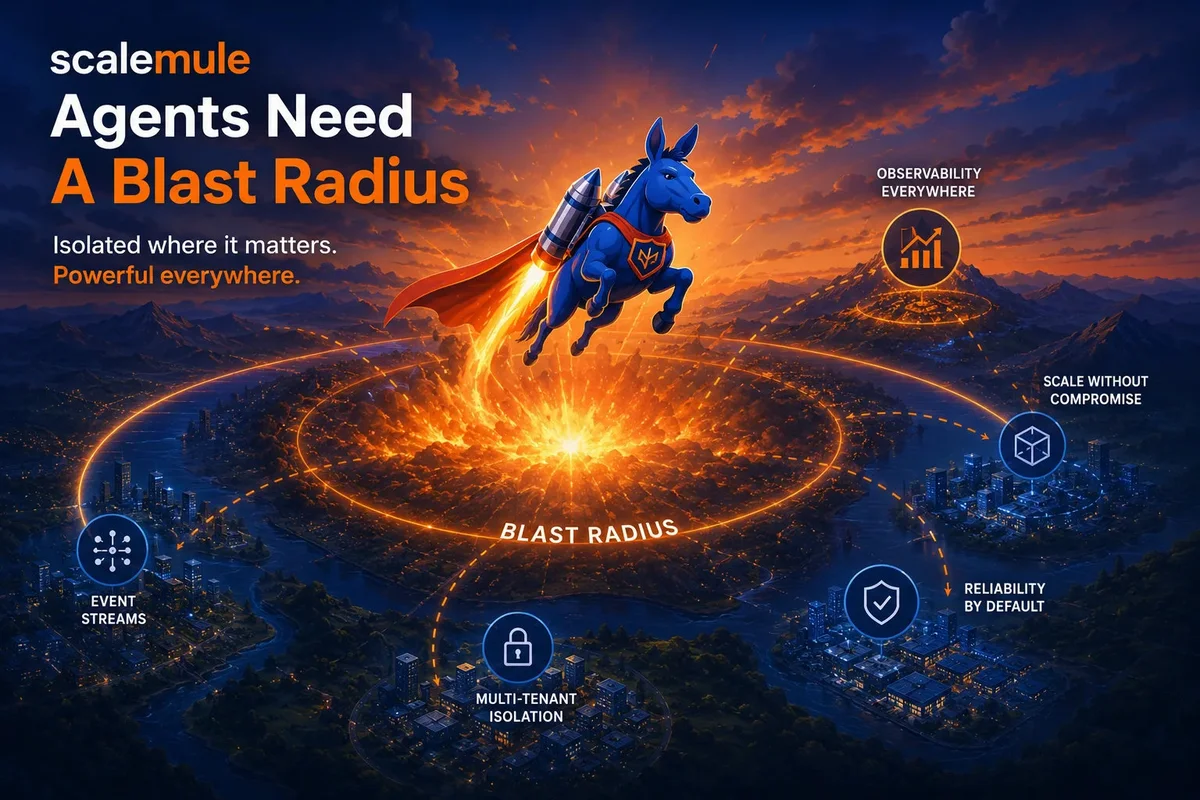
The agent needs a blast radius
A blast radius is the boundary around what can be affected when something goes wrong.
Every production agent needs one.
Not as an afterthought. Not as a dashboard setting someone remembers to configure later. As part of the core application substrate.
A useful blast radius has several parts.
Actor identity
Every action needs a clear actor.
Was this action taken by a human user, an API key, a service account, an integration, or an AI agent?
If it was an agent, which agent? Which version? Operating under whose authority? Using which credential? Inside which tenant or workspace?
Agent identity cannot be vague. "The AI did it" is not a useful audit trail.
Production systems need to know which actor performed which action, with which permissions, at which time, and on whose behalf.
Tenant boundaries
Agents should not operate in a global context unless the product is intentionally designed that way.
Most serious products are multi-tenant.
There are customers, workspaces, organizations, projects, teams, roles, environments, and billing boundaries.
An agent operating for Customer A should not be able to inspect, update, summarize, or infer private state from Customer B.
That sounds obvious, but agentic systems make it easier to accidentally blur boundaries because the agent may be reasoning across tools, memory, search results, documents, and prior actions.
Tenant context needs to be enforced by the infrastructure, not just included in the prompt.
Least privilege
Agents should not receive broad access just because it is convenient during development.
A support agent may need to summarize a ticket. That does not mean it should be able to change billing settings.
A deployment agent may need to inspect logs. That does not mean it should be able to rotate production secrets.
A content agent may need to generate media variants. That does not mean it should be able to delete the source library.
Least privilege is not only a security principle. For AI agents, it is a product design principle.
The smaller the permission envelope, the smaller the failure.
Event trails
Agent actions need durable event history.
Not just logs for debugging.
A real event trail should answer: What happened? What triggered it? Which actor performed it? Which tenant did it affect? Which inputs were used? Which tool was called? What changed? What was the result? Was a human involved? Was the action approved, rejected, retried, or reverted?
This matters for trust, debugging, compliance, customer support, billing, and operational recovery.
Without event history, the system cannot explain itself.
Approval gates
Not every action should be autonomous.
Some actions should be allowed immediately. Some should require confirmation. Some should require an admin. Some should be blocked entirely.
The important point is that the agent should not decide the approval policy by itself.
That policy belongs in the product infrastructure.
For example: reading a public help article may be safe. Drafting a response may be safe. Sending the response may require approval. Refunding a customer may require a manager. Changing account permissions may require an administrator. Deleting production data may be blocked or require a special workflow.
The agent can recommend. The system should enforce.
Reversibility
If agents are going to act, systems need better rollback patterns.
Some actions can be undone. Some can be quarantined. Some can be versioned. Some can be delayed before execution. Some should produce a draft instead of an immediate mutation.
Reversibility is what turns agentic systems from scary to manageable.
The goal is not to pretend agents will never make mistakes. The goal is to design the system so a mistake does not become a disaster.
Spend controls
Agents do not only touch data.
They can also consume resources.
They may call models, trigger compute jobs, process media, generate assets, call APIs, store files, or launch workflows that create downstream cost.
That means production agent infrastructure also needs commercial controls: which tenant owns the usage? Which workspace should be billed? Which plan allows this action? Which limits apply? When should usage be throttled? When should a human approve additional spend?
In AI products, cost is state.
If agents can create usage, then usage needs to be governed.
Controlled autonomy beats unlimited autonomy
The best production systems will not be the ones that give agents unlimited freedom.
They will be the ones that make agent freedom useful inside clear operating boundaries.
That is controlled autonomy.
An agent should be able to help. It should be able to take action. It should be able to coordinate tools. It should be able to reduce human workload.
But it should do that inside an environment where identity, permissions, tenant context, events, approvals, reversibility, and spend are built into the substrate.
That is the difference between a clever demo and a customer-ready product.
Why this matters for ScaleMule
This is the thesis behind ScaleMule, and it builds directly on the agent-native production substrate we have written about before.
The agent writes the product logic.
ScaleMule carries the production substrate.
ScaleMule is being built for AI and API products that need the infrastructure around the application, not just the application code itself.
That includes tenant-aware access, events, storage, audit trails, orchestration, operational controls, and commercialization workflows.
We are not trying to be the agent brain.
We are focused on the layer that makes agent-built and agent-operated products safer to run, easier to inspect, and more realistic to commercialize.
In practice, that means treating identity, tenant context, events, storage, policy, auditability, and usage controls as first-class product infrastructure, not as cleanup work after the demo.
Because as agents become more capable, the backend matters more, not less.
The question is no longer only:
Can the agent do the work?
The production question is:
Can the product safely contain what the agent is allowed to do?
That is where the next generation of AI infrastructure has to go.
ScaleMule review
See how ScaleMule carries the production substrate
See how an AI and API product can be built against one backend layer for identity, tenants, storage, events, policy, auditability, and operational state.
Sources
This post references public guidance from the NSA, CISA, and allied cybersecurity agencies on agentic AI adoption, along with public reporting from CyberScoop. ScaleMule is not affiliated with, endorsed by, or sponsored by the NSA, CISA, CyberScoop, or any third-party organization mentioned.