AI app builders are making software creation feel almost instant.
A team can describe a dashboard, customer portal, workflow, internal tool, landing page, or prototype and get something working faster than ever before.
That is a real breakthrough.
It changes who can participate in building software. It compresses the distance between an idea and a working product.
This is good.
Lovable, Replit, Bolt, Cursor, Claude, Codex, and similar tools are all part of the same larger shift: software creation is becoming more accessible, faster, and more distributed across the company.
But there is a second-order problem emerging.
As every team gains the ability to build, every team may also create its own backend.
One group builds a customer portal in Lovable. Another creates an internal workflow in Replit. A third spins up a campaign tool in Bolt. Engineering uses Cursor, Claude, Codex, or other agentic development tools to build a more durable service.
Later, some of these apps move to Vercel, AWS, GCP, an internal repository, or customer-specific production infrastructure.
The result is speed — but also fragmentation.
Every app can end up with its own version of users, roles, tenants, workspaces, permissions, API keys, usage logs, audit trails, storage rules, billing events, admin actions, and operational workflows.
That is not a software strategy.
That is backend sprawl.
The enterprise will not use one AI builder
A common mistake is assuming companies will standardize on one AI app platform.
That may happen in some places, but it is unlikely to be the general pattern.
Companies rarely standardize perfectly. Different teams have different needs. Product managers may prefer one builder. Designers may prefer another. Operations may use whatever gets an internal workflow live by Friday. Engineering may use code agents inside the existing repository.
A founder may prototype in one tool and later migrate the product to production infrastructure.
The future enterprise will likely use many AI builders at once.
That means the important question is not:
Which AI app builder will every company choose?
The more important question is:
What stays consistent when every team is building with different tools?
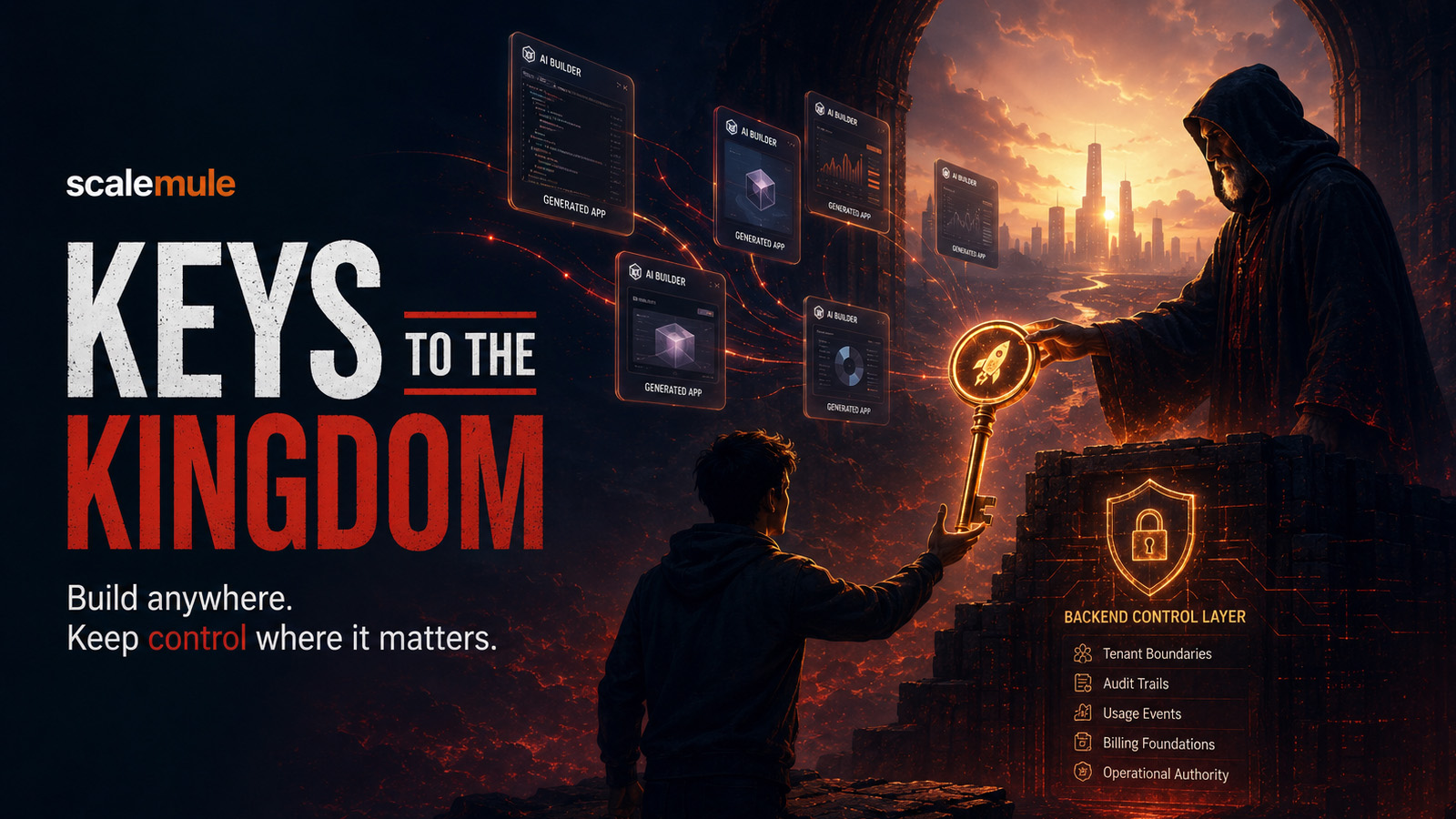
The answer should be the backend control layer.
The app can be disposable. The business layer cannot.
AI-generated apps will change quickly.
That is part of their value. Interfaces can be rebuilt. Workflows can be rewritten. Dashboards can be replaced. Prototypes can be discarded. Product logic can move from one host to another.
A rough internal tool can become a real customer-facing system. A one-off experiment can become a revenue-generating product.
The app layer becomes more fluid.
But the business layer should not be fluid.
A company should not casually scatter its durable operating memory across every generated app:
- Customer identities
- Tenant boundaries
- Multi-tenant access rules
- Workspace membership
- Roles and permissions
- API keys
- Usage events
- Audit trails
- Billing-relevant activity
- Storage and media rules
- Admin actions
- Approval workflows
- Operational event history
That is the kingdom.
AI builders can help create the castle.
But companies should be careful about giving every builder the keys to the kingdom.
Hosting is not the same as backend control
Many AI app builders are moving beyond generation. They are adding hosting, databases, authentication, integrations, monitoring, payments, analytics, and enterprise controls.
That makes sense.
The more complete the platform, the easier it is for users to go from idea to live product without stitching together infrastructure manually.
But for companies, this creates a strategic question:
Should every generated app become its own backend island?
If a team builds in one platform, another team builds in another, and a third team builds in a code agent connected to the internal repo, the company may quickly end up with multiple disconnected versions of the same business primitives.
One app has its own user table.
Another has its own workspace model.
Another has a different permission structure.
Another records usage events in a different format.
Another has no real audit trail.
Another stores customer files without the same access model.
Another has billing logic added later as a patch.
Each individual app may work.
The company’s software estate becomes harder to govern.
Backend fragmentation is the new technical debt
In the previous era, technical debt often came from slow-moving codebases, legacy systems, and custom internal tools that no one wanted to maintain.
In the AI app-builder era, a new kind of technical debt appears:
Too many apps built too quickly without a shared control layer.
This is a strange problem because it starts as success.
Teams are moving faster. More people can build. Prototypes become real. Internal bottlenecks shrink. Ideas no longer wait months for engineering bandwidth.
But speed without a consistent backend model creates a hidden cost.
Over time, the company has to answer difficult questions:
- Which system owns the customer?
- Which app owns the tenant?
- Where are roles and permissions enforced?
- Where is usage measured?
- Where are audit logs reviewed?
- Where do billing events come from?
- Which storage rules apply?
- Which app has the source of truth?
- Who can approve sensitive changes?
- How do we move from prototype to production without rebuilding everything?
These are not cosmetic questions.
They are the questions that determine whether AI-built software can become trusted business software.
Standardize the backend, not the builder
The answer is not forcing every team to use one AI builder.
That may slow down the exact creativity and speed companies are trying to unlock.
A better model is:
Use any AI builder. Keep one backend control layer.
Teams should be able to prototype with any AI builder or custom engineering workflow. But the company's backend control should remain consistent.
The generated app can change.
The host can change.
The frontend can change.
The product logic can evolve.
But the company should keep one durable layer for:
- Tenants
- Users
- Roles
- Workspaces
- API keys
- Usage events
- Audit trails
- Storage controls
- Billing foundations
- Operational workflows
This gives companies the best of both worlds.
Teams move fast at the app layer.
The company stays coherent at the backend layer.
Build anywhere. Route through a consistent backend.
This is the direction ScaleMule is built for.
ScaleMule is a platform-agnostic backend and gateway for agent-built products.
The idea is simple:
Build the interface anywhere. Route the backend paths that matter through ScaleMule.
A team can build an app with an AI builder and still use a consistent backend control layer for customer scope, permissions, events, audit, usage, storage, and billing foundations.
That means the app does not need to own every critical business primitive itself.
Instead of every generated product inventing its own backend model, the company can route important actions through one control layer:
- A user signs up
- A workspace is created
- A role changes
- A file is uploaded
- A paid feature is used
- An API key is issued
- A sensitive action requires review
- A webhook fires
- A usage event is recorded
- A customer asks what happened
- A billing-relevant event needs to be captured
Those paths should not be buried differently inside every generated app.
They should be explicit, reviewable, portable, and consistent.
Portability matters
There is another reason this matters: AI-built products will move.
A company may start with a Lovable prototype, rebuild parts in Replit, export to GitHub, deploy on Vercel, move backend workloads to AWS, and later bring certain services into an internal platform.
That should not require rebuilding the business layer every time.
If the backend control layer is independent, the company gains portability.
The app builder can change.
The deployment target can change.
The implementation can change.
But the tenant model, access rules, usage history, audit trail, and billing-relevant events can remain stable.
This is especially important in the AI era because the cost of generating new software is dropping. When software becomes easier to recreate, the durable value shifts toward the systems of record and control around it.
Generated apps should be easy to replace.
Business-critical state should not be.
The new enterprise question
As AI app builders spread, companies will need to ask a new architecture question before every generated app becomes a small production system:
Where does the company's backend truth live?
Not just where the app is hosted.
Not just where the code is generated.
Not just which tool created the UI.
But where the durable control layer lives.
Where are tenants defined?
Where are permissions enforced?
Where are events recorded?
Where are audit trails reviewed?
Where is usage visible?
Where are billing-relevant events recorded?
Where are customer-facing operations made explicit?
If every app answers those questions differently, the company will eventually pay for that speed with operational confusion.
If those answers live in one backend control layer, AI-built software becomes much more manageable.
Use every builder. Keep the keys.
The rise of AI app builders is not a threat to companies.
It is an opportunity.
The future will likely include more builders, more agents, more generated interfaces, more internal tools, more prototypes, and more software created by people who were previously blocked from building.
That is a good thing.
But companies should separate the creative layer from the control layer.
Use Lovable.
Use Replit.
Use Bolt.
Use Cursor.
Use Claude.
Use Codex.
Use internal agents.
Use whatever helps your teams build faster.
Just do not let every generated app become its own isolated backend kingdom.
Keep the keys where the company can govern them.
That is the shift ScaleMule is focused on: a platform-agnostic backend and gateway for AI-built products, so teams can build anywhere while the business-critical backend stays consistent.
AI demos are easy.
Consistent backends are not.
That is where the next layer of infrastructure belongs.
Technical review
See how ScaleMule keeps backend control consistent across AI-built products
Explore how generated apps can route identity, tenants, storage, events, auditability, usage, and operational state through one platform-agnostic backend layer.