AI is making software creation faster.
A founder, product team, or internal operator can now describe a workflow and get a working app, dashboard, agent, API route, or customer-facing prototype in hours instead of weeks.
That is a real shift.
But it also exposes a new bottleneck.
The hard part is no longer just producing product logic. The hard part is turning generated product logic into something customers, partners, and enterprises can actually trust.
The next platform category is not just "AI that writes code."
It is the production substrate around the code.
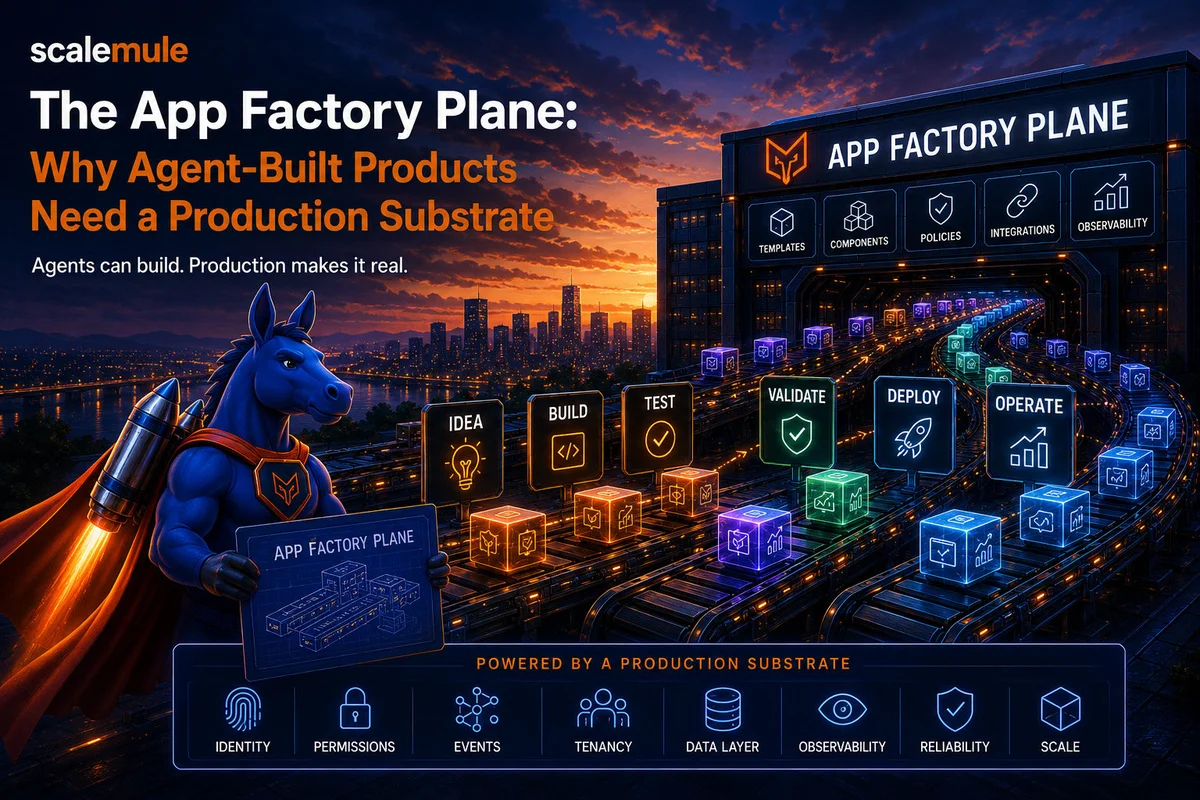
At ScaleMule, we think of this as the app factory plane.
Not a no-code toy. Not a prompt wrapper. Not a place where every product becomes the same.
The app factory plane is the reusable operational layer that lets many products move from generated logic to customer-ready systems without rebuilding the same production foundations every time.
Product logic is becoming cheap. Production context is not.
AI can generate a feature.
It can create a landing page.
It can write an API.
It can scaffold a dashboard.
It can assemble a workflow.
It can connect services together.
But once that product touches real users, the questions change.
Who can access this?
Which customer does this request belong to?
What environment is this running in?
What happens when a webhook fails?
Where are files stored?
Who changed this setting?
What is billable?
What should be visible to support?
What should be visible to the customer?
What can be reviewed before launch?
Those are not small details.
They are the difference between a demo and a product.
The old software stack assumed slow creation.
Traditional software infrastructure was built around a slower rhythm.
A team would spend months defining requirements, building the backend, shaping the data model, setting up auth, adding billing, building admin tools, and eventually launching.
The application and the infrastructure evolved together.
AI changes that rhythm.
Now product surfaces can appear before the production boundary is ready.
That creates a mismatch.
The app can look finished before the system underneath it is ready for customers.
The result is a growing gap between generated product logic and production readiness.
The app factory plane closes that gap.
An app factory plane gives generated products a reusable place to land.
It makes the core operational concerns explicit:
Access.
Tenants.
Events.
Storage.
Audit trails.
Usage.
Billing foundations.
Operational control.
These primitives should not be rebuilt from scratch for every new product surface.
They should be available as a reusable production boundary.
That way, product teams can keep moving quickly on product logic while the production layer stays consistent, inspectable, and reviewable.
A simple example
Imagine a team uses AI to generate three product surfaces in the same week:
A customer portal.
An internal operations dashboard.
A partner-facing API.
Each surface looks different. Each one serves a different user. Each one may evolve independently.
But underneath, the same production questions appear again:
Who is the actor?
Which tenant owns the data?
Which events should be recorded?
Which files or media assets are attached?
Which actions are billable?
Which changes need to be audited?
Which parts should support or operations be able to inspect?
Without a shared production substrate, each new surface becomes another one-off backend project.
With an app factory plane, the product logic can move quickly while identity, tenancy, events, storage, auditability, usage, and operational control remain consistent.
This matters even more for agent-built software.
Agent-built software will not always be a single application.
It may be a collection of workflows, tools, APIs, media flows, customer portals, internal automations, and partner-facing surfaces.
Some of those surfaces may be generated.
Some may be manually written.
Some may be changed frequently by agents.
Some may be packaged into products.
Some may be exposed to customers.
Without a reusable production boundary, every new surface creates new operational risk.
Access rules get scattered.
Tenant context gets buried in application code.
Events become one-off glue.
Billing is added late.
Admin actions are hard to review.
Support teams cannot see what happened.
Enterprise buyers cannot evaluate the system clearly.
The more AI accelerates software creation, the more important the stable production layer becomes.
The factory is not the app.
This is an important distinction.
The app factory plane should not erase product uniqueness.
It should not force every product to look the same.
It should not require every team to ask the platform team for every change.
It should not make the infrastructure company the operator of every product.
The factory is the reusable production layer.
The product team still owns the product experience, customer workflow, positioning, and business logic.
The factory simply gives those products a stable operational base.
That base includes identity, tenant scope, storage, events, auditability, usage visibility, billing foundations, and other controls that make the product easier to launch, review, and scale.
Why this becomes a company-building advantage.
For a single product, reusable infrastructure saves time.
For a portfolio of products, it becomes strategic.
A founder studio, platform company, agency, or AI-native product team may want to create many products from shared primitives.
One product might need media uploads.
Another might need customer workspaces.
Another might need ticket-linked collaboration.
Another might need usage tracking.
Another might need billing workflows.
Another might need partner packaging.
The product surfaces are different.
But many of the production needs repeat.
That is where the app factory plane becomes leverage.
It lets teams build products faster without treating every launch as a fresh infrastructure rebuild.
The evaluation layer matters too.
A customer-ready product does not only need to function.
It needs to be reviewable.
A technical buyer, enterprise customer, partner, or investor may want to understand:
How access works.
How customer data is scoped.
How events are handled.
How usage is measured.
How operational actions are audited.
How billing could work.
How the product can scale beyond the first prototype.
When these answers are buried inside a generated codebase, review becomes difficult.
When they are exposed through a reusable production layer, the product becomes easier to trust.
ScaleMule's view.
ScaleMule is being built around this production boundary.
The current platform focuses on the primitives AI and API products need after the demo: tenant-aware access, events, storage, audit trails, usage tracking, billing foundations, and operational visibility.
The goal is simple:
Help teams move generated product logic into customer-ready systems.
That does not mean every product becomes the same.
It means every product gets a stronger production base.
The next bottleneck is not generation.
AI will keep making generation cheaper.
More apps will be created.
More workflows will be automated.
More internal tools will become products.
More founders will be able to build without large engineering teams.
But the bottleneck will move.
The question will not be:
"Can we generate the app?"
The question will be:
"Can we make this generated product safe, reviewable, commercializable, and ready for real customers?"
That is the work of the app factory plane.
And that is the layer ScaleMule is building.
ScaleMule review
See how ScaleMule carries the production substrate
See how an AI and API product can be built against one backend layer for identity, tenants, storage, events, policy, auditability, usage, and operational state.