AI will make software easier to create.
That is the obvious part.
The less obvious part is what happens next.
When software becomes easier to create, companies do not simply become simpler. They create more tools, more workflows, more integrations, more customer surfaces, more agent actions, more product experiments, and more ways to express how their business actually works.
That is not a bug.
That is the opportunity.
The best companies will not use AI merely to reduce complexity. They will use AI to take on more valuable complexity: more specific customer workflows, more differentiated product experiences, more proprietary operating logic, and more adaptive software surfaces than their competitors can manage.
The question is not whether AI reduces complexity.
The question is whether a company can control the complexity that creates advantage.
That requires a simple architectural rule:
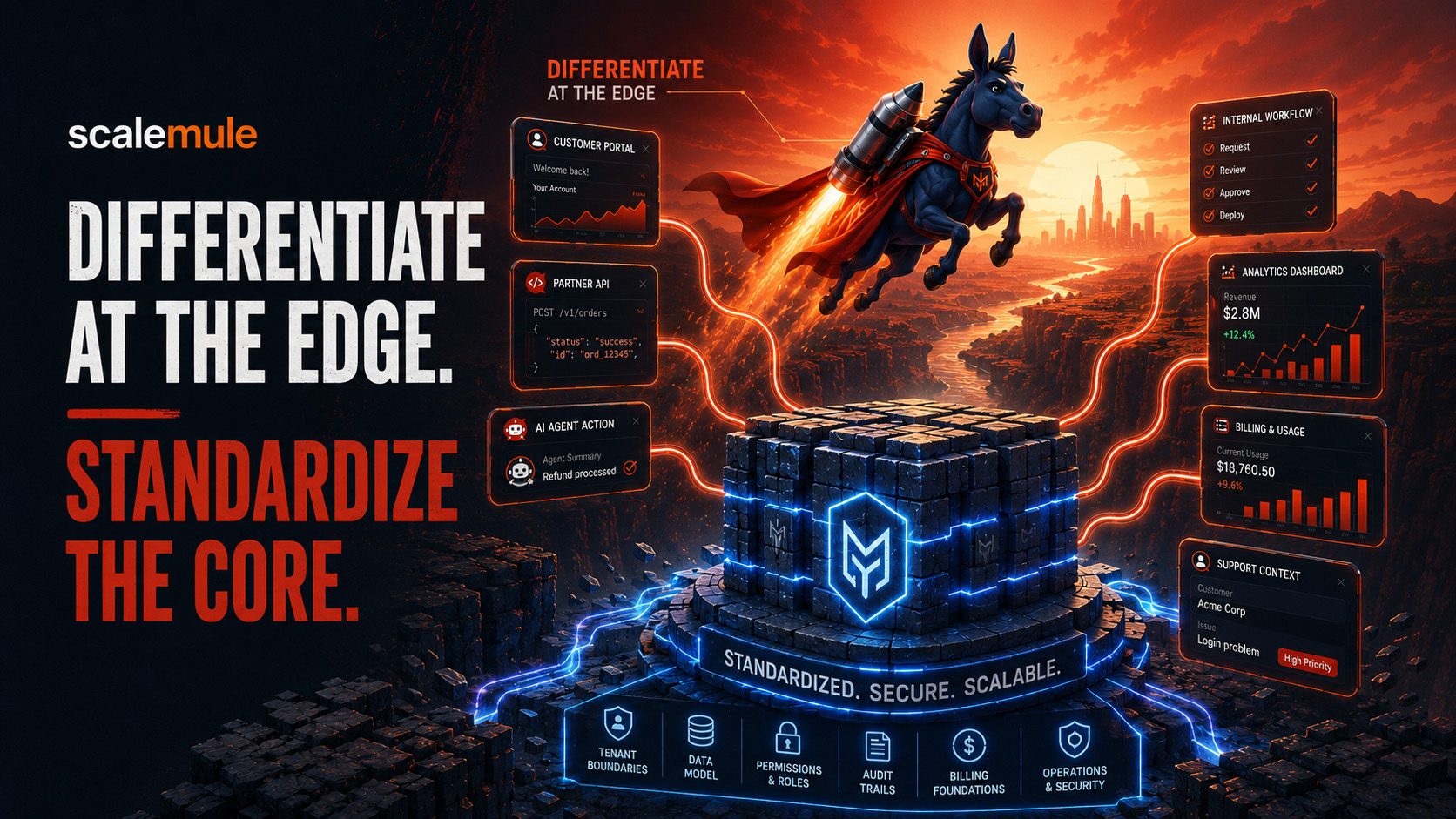
Differentiate at the edge.
Standardize the core.
Control the complexity in between.
AI makes software abundant
A product manager can describe a workflow and get a prototype.
An operations team can automate a manual process.
A founder can build a customer portal.
An engineer can ask an agent to scaffold a service, write tests, connect APIs, or refactor a module.
More people can build.
More ideas can become software.
More work can be automated.
This is good.
But software abundance changes the shape of the company.
The old bottleneck was often creation.
Software took time to design, build, review, deploy, and maintain. That slowed companies down, but it also limited the number of systems created.
AI changes that rhythm.
Now code can appear faster than the organization can review, govern, integrate, and operate it.
That means complexity does not disappear.
It moves.
From writing code to supervising code.
From building features to managing boundaries.
From creating apps to governing systems.
From individual productivity to organizational coherence.
The companies that win will not be the ones that generate the most code.
They will be the ones that turn software abundance into controlled differentiation.
Local simplicity can create system complexity
Inside a company, every team has an incentive to reduce its own complexity.
Support wants fewer manual steps.
Sales wants cleaner handoffs.
Operations wants less spreadsheet work.
Finance wants better reconciliation.
Product wants faster experiments.
Engineering wants fewer repetitive implementation tasks.
AI helps each group move faster.
A team that used to wait months for an internal tool may now create one in days.
A workflow that used to require manual coordination may become an automation.
A dashboard that used to sit in a backlog may become a working interface.
Each local improvement may be rational.
But across the company, the result can become more complex.
One team creates a customer workflow.
Another creates a partner portal.
Another creates an internal dashboard.
Another creates a billing helper.
Another creates an AI agent that touches customer data.
Another creates an automation that updates records across systems.
Each one reduces pain somewhere.
But now the company has to answer harder questions:
Who owns the customer record?
Which system defines the tenant?
Where are permissions enforced?
Which events are reliable?
Which workflow is auditable?
Which automation can make changes?
Which usage is billable?
Which data path is safe?
Which system is the source of truth?
AI reduces the cost of creating software.
It does not automatically reduce the cost of governing software.
External complexity will increase too
The complexity is not only internal.
AI will also increase the number of external surfaces companies are expected to provide.
Customers will expect more self-serve workflows.
Partners will expect better APIs.
Enterprise buyers will expect integrations into their systems.
Support teams will expect customer-specific context.
Finance teams will expect usage visibility.
Operations teams will expect automation around approvals, exceptions, and handoffs.
The market expectation changes from:
Do you have software?
to:
Can your software adapt to our workflow?
That is a much harder standard.
A company may need to expose customer portals, partner dashboards, usage APIs, embedded automations, AI-agent actions, workflow integrations, audit trails, admin controls, and reporting surfaces.
Some of those surfaces will start as internal tools.
Then customers will ask for access.
Partners will ask for a version of the same workflow.
Sales will ask whether it can become a feature.
Support will ask whether it can be exposed safely.
Finance will ask whether the usage can become billable.
The boundary between internal automation and external product will blur.
That is where complexity compounds.
An internal workflow may become a customer-facing feature.
A support tool may become part of the customer experience.
A billing event may become a usage API.
A partner integration may become a product surface.
AI will not only help companies build more software.
It will create more external obligations.
The goal is not less complexity
There is a tempting but incomplete story about AI and software.
The story says AI will automate work, remove friction, simplify operations, and reduce the need for custom systems.
Some of that will happen.
But the more important story is that AI will make it cheaper for companies to express their differences in software.
A company with a unique service model can turn that model into workflows.
A company with proprietary data can turn that data into product surfaces.
A company with deep domain expertise can turn that expertise into agents.
A company with a better operating process can turn that process into automation.
A company with strong distribution can expose more tailored customer experiences.
That is not standardization.
That is differentiation.
The mistake would be to let every differentiated surface create a separate backend universe underneath it.
The edge should be dynamic.
The core should be durable.
The advantage comes from knowing which is which.
The enterprise incentive is not sameness
This does not mean every company should use the same software.
That would be the wrong lesson.
Companies want automation because they want leverage.
But they also want differentiation.
A logistics company does not want to operate exactly like a bank.
A healthcare company does not want the same workflow as a media company.
A marketplace does not want the same business logic as an enterprise SaaS company.
The unique parts matter.
Customer experience matters.
Business process matters.
Pricing logic matters.
Operational judgment matters.
Data advantage matters.
Distribution matters.
Domain expertise matters.
Those are places where companies should be different.
AI will make those differences easier to express in software.
That is the opportunity.
But not every layer deserves to be unique.
Most companies do not need fifty different ways to define a user.
They do not need every generated app to invent its own tenant model.
They do not need every workflow to create a separate audit trail.
They do not need every automation to decide its own permission rules.
They do not need billing-relevant events hidden inside one-off product code.
The strategic move is not to standardize the business.
It is to standardize the substrate.
Differentiate at the edge
The edge is where the company touches the market.
It is the customer experience.
The workflow.
The interface.
The pricing motion.
The partner experience.
The service model.
The data advantage.
The domain-specific product logic.
This is where companies should be creative.
AI will make the edge more dynamic.
Teams will test more surfaces.
Customers will ask for more specific workflows.
Agents will generate more variations.
Internal tools will become product candidates.
Product teams will ship more experiments.
Enterprise buyers will expect software that fits their operating model.
That is not a problem to avoid.
That is the new competitive surface.
When software becomes easier to create, companies should use that abundance to express what makes them different.
But differentiation at the edge only works if the core does not fragment underneath it.
Standardize the core
The core is where the company keeps its durable production truth.
Identity.
Tenants.
Roles.
Permissions.
Events.
Storage.
Audit trails.
Usage.
Billing foundations.
Approval gates.
Operational visibility.
Customer scope.
Environment boundaries.
Support context.
These are not the places where every team should improvise.
They are the places where consistency creates speed.
If every product surface invents its own core, the company may move fast at first and slow down later.
One app has its own user table.
Another has its own workspace model.
Another has a different permission structure.
Another records usage events in a different format.
Another has no reliable audit trail.
Another stores customer files without the same access model.
Another adds billing logic after launch as a patch.
Each individual system may work.
The company becomes harder to operate.
A consistent core lets teams move faster without making the company less coherent.
The interface can change.
The workflow can change.
The AI builder can change.
The host can change.
The product logic can evolve.
But the production truth should remain stable.
Control the complexity in between
The hardest part is the layer between the dynamic edge and the standardized core.
That is where product actions become business events.
A user signs up.
A workspace is created.
A role changes.
A file is uploaded.
A paid feature is used.
An API key is issued.
A sensitive action requires review.
A webhook fires.
A usage event is recorded.
A customer asks what happened.
A billing-relevant event needs to be captured.
These paths should not be buried differently inside every generated app.
They should be explicit, reviewable, portable, and consistent.
That is what turns software abundance into operational leverage.
Without that control layer, AI-built systems become another form of sprawl.
With that control layer, companies can let more teams build, more agents operate, and more product surfaces emerge without losing the ability to govern the business.
The app can be fluid. The business layer cannot.
AI-built products will move.
A company may start with a prototype in one builder, rebuild parts in another, export to a repository, deploy on a cloud platform, move backend workloads to internal infrastructure, and later expose parts of the workflow to customers or partners.
That should not require rebuilding the business layer every time.
Generated apps should be easy to replace.
Business-critical state should not be.
The app layer can be fluid because the core remains durable.
That is the architecture shift AI is forcing.
When software creation becomes abundant, the durable value moves toward the systems of record and control around it.
AI makes architecture more important
AI will make code cheaper.
That does not make architecture less important.
It makes architecture more important.
When code was expensive, companies were naturally constrained by the difficulty of producing it.
When code becomes cheaper, the constraint moves to coherence.
Can the company understand what it has built?
Can it govern what its agents are doing?
Can it reuse business-critical primitives across products?
Can it expose new surfaces without creating new security gaps?
Can it preserve customer trust while moving faster?
Can it turn internal automation into external product without rebuilding the foundation?
These become strategic questions.
Not just technical questions.
Because the way a company controls its software surfaces will shape how fast it can learn, how safely it can automate, how much it can personalize, and how quickly it can turn proprietary knowledge into product.
Where ScaleMule fits
ScaleMule is built for the AI software era, where more products, agents, workflows, APIs, and customer surfaces will be created faster than traditional backend architectures were designed to absorb.
The goal is not to make every product look the same.
The goal is to let companies differentiate more aggressively without fragmenting the production layer underneath.
ScaleMule focuses on the backend control layer behind AI and API products: tenant-aware access, identity, events, storage, auditability, usage, billing foundations, and operational control.
Teams should be able to build new interfaces, internal tools, customer portals, partner APIs, and agent-powered workflows with the tools that help them move fastest.
But the company should not have to rebuild its business-critical core every time a new software surface appears.
AI makes the edge more dynamic.
That makes the core more strategic.
The companies that win will not be the ones that generate the most code.
They will be the ones that turn software abundance into controlled differentiation.
Technical review
See how ScaleMule keeps the production core consistent across AI-built products
Explore how AI-generated apps, internal tools, customer portals, partner APIs, and agent-powered workflows can route identity, tenants, permissions, events, auditability, usage, and operational control through one consistent backend layer.