AI rollups sound simple.
Buy fragmented businesses. Add AI. Improve margins. Scale faster.
It is an attractive story because it feels obvious. Many service businesses are still run on spreadsheets, inboxes, disconnected SaaS tools, manual handoffs, and fragile operating processes. AI can clearly help with support, scheduling, sales, reporting, document processing, customer communication, and internal operations.
But the hard part is not adding AI.
The hard part is making many different businesses operate like one company without destroying what makes each one valuable.
Every acquired, launched, or AI-enabled business brings its own version of the same messy foundation: customer records, user accounts, permissions, billing rules, workflows, integrations, data storage, audit trails, support processes, onboarding steps, reporting, and operational controls.
AI does not automatically fix that.
In many cases, AI makes the mess grow faster.
When software becomes easier to generate, every team can create another tool, another workflow, another dashboard, another integration, another customer experience, and another exception. The company may feel more productive for a few weeks, but underneath the surface the operating system becomes more fragmented.
The next great AI rollup will not win because it has the most AI.
It will win because it has the best operating layer.
The rollup fantasy skips the hard part
The fantasy version of an AI rollup looks like this:
Acquire a group of fragmented businesses.
Add AI agents and automation.
Reduce manual work.
Improve margins.
Cross-sell services.
Scale the platform.
That can work.
But only if the company can actually operate the businesses as a platform.
If every business has a different identity system, billing model, workflow engine, customer database, admin process, reporting structure, and permission model, the rollup does not become more efficient. It becomes harder to manage.
The company may own more revenue, but it also owns more operational complexity.
This is where many technology strategies quietly fail. The visible product surface looks modern. The demos look impressive. The AI assistant answers questions. The landing page says "automated." But behind the scenes, the company still depends on manual reconciliation, one-off scripts, fragile admin access, inconsistent customer data, and undocumented operational knowledge.
That is not a platform.
That is a pile of software.
The secret behind AI rollups
The secret behind AI rollups is that they are not really about AI first.
They are about operational standardization.
AI creates the opportunity because it makes more work automatable and more software easier to create. But that also means the number of workflows, tools, agents, customer touchpoints, and data surfaces grows faster than the company's ability to govern them.
The obvious question is:
Where can we add AI?
The better question is:
What must become standardized so every future business is easier to operate than the last one?
That is where the moat forms.
Not in one chatbot.
Not in one workflow.
Not in one vertical application.
The moat forms in the shared commercial core that makes every acquired, launched, or AI-enabled business cheaper to run, easier to govern, faster to monetize, and safer to improve.
The model is not the moat.
The wrapper is not the company.
The operating layer is where the rollup compounds.
AI wrappers are not enough
Adding AI to a messy operating core creates a better-looking mess.
An AI assistant can summarize a customer conversation, but it still needs to know which customer, which account, which contract, which permissions, which workflow state, which billing plan, and which data it is allowed to access.
An AI sales agent can follow up with a lead, but it still needs to understand who owns the relationship, what has already been promised, what the customer is allowed to buy, which terms apply, and what should be recorded for future teams.
An AI operations assistant can recommend the next step, but it still needs reliable context from the system of record.
An AI support agent can draft a response, but it still needs auditability, escalation paths, role-based permissions, and a way to preserve the history of what happened.
The AI is not the whole product.
The AI is an interface into the operating system.
If the operating system is fragmented, the AI will be fragmented too.
A rollup made of wrappers is still fragmented
Imagine a founder buys three service businesses and adds AI workflows to all of them.
The demos work.
The AI can answer customer questions.
The AI can draft follow-ups.
The AI can summarize documents.
The AI can produce reports.
But a few months later, the founder has three customer databases, three billing patterns, three permission models, three onboarding flows, three support queues, three reporting systems, and no unified view of what is actually happening across the company.
The AI demos worked.
The operating company did not.
This is the trap.
AI can make each individual business look more modern while the combined company becomes more difficult to operate.
The rollup has more automation, but not more leverage.
It has more tools, but not more standardization.
It has more software, but not a stronger company.
The bottleneck has moved
Before AI, building software was expensive enough that companies had to be selective. Every internal tool, customer portal, workflow, dashboard, and integration required real engineering time.
That constraint was painful, but it also forced discipline.
Now the constraint is changing.
Software creation is becoming easier.
Software operation is becoming the bottleneck.
A company can generate more product surfaces, more workflows, more automations, more agents, and more internal tools than it can safely govern.
That is a major shift.
The scarce resource is no longer only the ability to build software.
The scarce resource is the ability to turn software into a reliable operating system for the business.
That is especially true for AI rollups.
When every acquired business can suddenly create more software, more automations, and more customer-facing AI experiences, the need for a shared operating core becomes urgent.
Without it, the rollup does not compound.
It splinters.
Differentiate at the edge. Standardize the core.
The goal is not to make every business in a rollup look the same.
That would be a mistake.
The edge should remain different.
Each company should keep its brand, customer relationship, vertical workflow, domain expertise, specialized user experience, and unique value proposition.
A roofing business should not feel like a legal services business.
A healthcare operations company should not feel like a recruiting company.
A creator agency should not feel like a logistics company.
The customer-facing experience should be specific, opinionated, and tailored to the market.
But the core should not be reinvented every time.
Identity should not be rebuilt for every product.
Billing should not be invented from scratch for every business.
Auditability should not depend on which team built the workflow.
Permissions should not be scattered across application code.
Customer onboarding should not require manual heroics.
Usage data should not live in disconnected spreadsheets.
The edge is where the business differentiates.
The core is where the business compounds.
That is the operating principle:
Differentiate at the edge. Standardize the core.
AI increases the need for trust
Before AI, fragmented software was already painful.
With AI, fragmentation becomes riskier.
AI systems need context. They need access. They need memory. They need instructions. They need the ability to act. They need to communicate with customers, employees, tools, databases, and third-party systems.
That makes the operating layer more important, not less.
A company needs to know who the user is, which customer they represent, what they are allowed to see, what they are allowed to change, which workflow is active, which system is the source of truth, what should be logged, what should be billed, what should be escalated, and what should never be exposed to the model.
These questions cannot be answered by a prompt alone.
They require infrastructure.
The more AI is used inside real businesses, the more important the underlying systems become: identity, permissions, usage, billing, auditability, workflow state, and operational controls.
The operating layer is not boring because it is unimportant.
It is boring because it must be reliable enough to disappear.
The best AI companies will look operationally disciplined underneath
The most valuable AI-enabled companies may look magical to customers.
They may automate work that used to take hours. They may deliver better service with smaller teams. They may personalize experiences at scale. They may turn expert knowledge into repeatable workflows. They may make old industries feel modern.
But underneath, the best ones will look disciplined.
They will know who can access what.
They will meter usage.
They will bill reliably.
They will preserve audit trails.
They will support customers without guessing.
They will onboard new accounts predictably.
They will connect AI actions to real operational records.
They will know what happened, when it happened, who initiated it, and what system acted.
That is what makes AI commercially useful.
Not just intelligence.
Operational reliability.
Rollups need a shared substrate
An AI rollup should not have to rebuild the same foundation for every company it acquires or launches.
It needs a shared substrate that lets each business move faster without creating chaos.
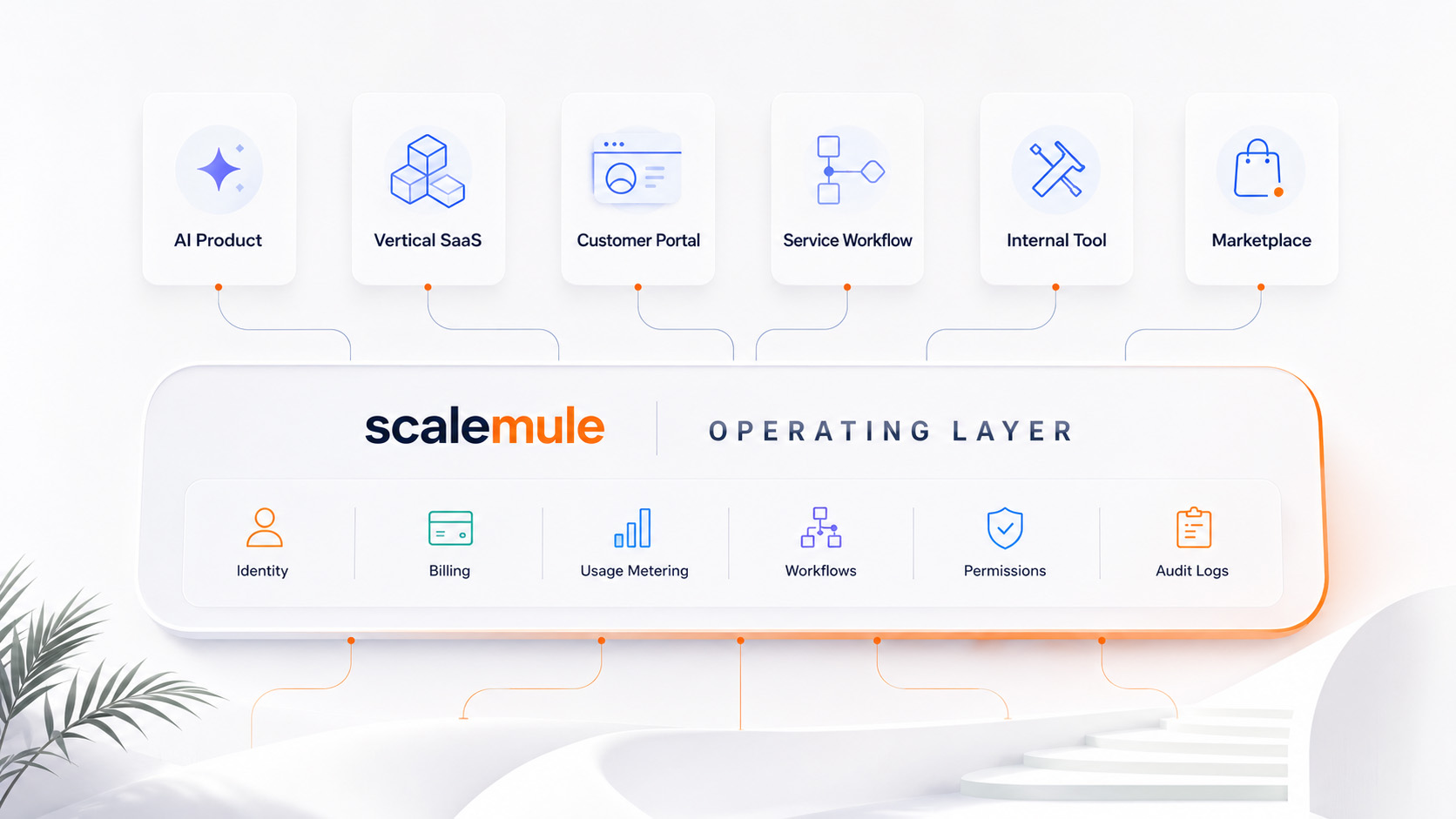
That substrate should make it easier to launch, operate, and scale many AI-enabled products with common foundations:
One way to handle identity.
One way to understand customers and tenants.
One way to enforce permissions.
One way to track usage.
One way to support billing.
One way to observe workflows.
One way to preserve auditability.
One way to operate across products without turning every product into a custom project.
The shared substrate does not replace the vertical product.
It makes the vertical product easier to commercialize.
It lets the product team focus on the customer problem instead of rebuilding the same commercial machinery again and again.
That is the same gap ScaleMule calls the production substrate around the code: the reusable operational layer that lets product surfaces move from generated logic to customer-ready systems.
The rollup moat is not just acquisition
Buying companies is not enough.
Adding AI is not enough.
Hiring smart operators is not enough.
The moat comes from turning repeated operational patterns into a platform.
When each new business makes the operating core stronger, the rollup compounds.
The identity model improves.
The billing patterns become reusable.
The workflow events become standardized.
The audit trail becomes trusted.
The integrations become repeatable.
The next business becomes cheaper to launch than the last one.
That is the difference between a holding company with AI tools and a true AI operating platform.
A holding company owns many businesses.
A platform makes every business easier to operate than the last one.
What should be standardized before the rollup scales?
AI rollups should not start only by asking:
Where can we add AI?
They should also ask:
What should be standardized before we scale?
Where are we rebuilding the same foundation over and over again?
Which customer records, workflows, permissions, and billing rules need to become reusable?
Where do we need one source of operational truth?
Which AI actions need auditability?
Which customer experiences should remain unique?
Which parts of the business should compound across acquisitions?
Those questions are less glamorous than "What can the AI agent do?"
They are also more important.
The companies that answer them early will be able to scale faster with less chaos.
The companies that ignore them will keep adding automation on top of fragmentation.
ScaleMule's point of view
ScaleMule is built around a simple belief:
AI will make it easier to create products, but harder to operate them as real businesses.
The world does not need more demos that almost work.
It needs more companies that can safely take AI-built and AI-enabled software to customers.
That requires the production substrate behind the product: identity, tenancy, billing, usage, workflows, auditability, integrations, permissions, operational controls, and customer readiness.
For AI rollups, this substrate becomes even more important.
A rollup does not need twenty different versions of the same backend foundation.
It needs one operating layer that makes each new business easier to launch, manage, govern, monetize, and improve.
That is the role ScaleMule is designed to play.
Not another AI app builder.
Not another demo generator.
Not another dashboard.
The operating layer for AI-built and AI-enabled companies that need to become commercially real.
As we wrote in A Demo Is Not a Company, customers do not buy demos. They buy software that can onboard users, manage permissions, collect payments, track usage, support teams, and operate safely.
The companies that win will standardize what customers do not see
Customers do not usually care how identity is implemented.
They do not ask whether usage events are clean.
They do not think about audit trails until something goes wrong.
They do not care how billing infrastructure works unless the invoice is wrong.
They do not care how permissions are enforced unless someone sees something they should not.
They do not care how workflows are tracked unless work gets lost.
But these are exactly the things that determine whether a company can scale.
The customer sees the edge.
The company survives because of the core.
That is why AI rollups should not treat the operating layer as an afterthought.
It is not back-office plumbing.
It is the foundation that determines whether the rollup can become more than a collection of acquired businesses and AI wrappers.
The next great rollup will be an operating company
The first wave of AI rewarded demos.
The next wave will reward operating leverage.
AI rollups that only add wrappers will create temporary excitement.
AI rollups that standardize the core will create durable companies.
The winners will understand that AI is not a substitute for operating discipline.
It is a force multiplier for companies that already have it.
Buy the companies.
Keep the edge specific.
Make the customer experience better.
Use AI where it creates leverage.
But standardize the core.
That is how an AI rollup becomes more than a collection of businesses.
That is how it becomes a platform.
The model is not the moat.
The wrapper is not the company.
The operating layer is where the rollup compounds.
AI rollup operating layer
Standardize the core behind AI-enabled companies
See how ScaleMule helps AI-built and AI-enabled products route identity, billing, usage, workflows, permissions, auditability, and operational control through one reusable production substrate.